
Class 4 Grammar Worksheet on Correcting Homophones

Class 4 Grammar Worksheet on Correcting Homophones
Sound Alike, Different Meanings: Correcting Homophone Errors for Grade 4
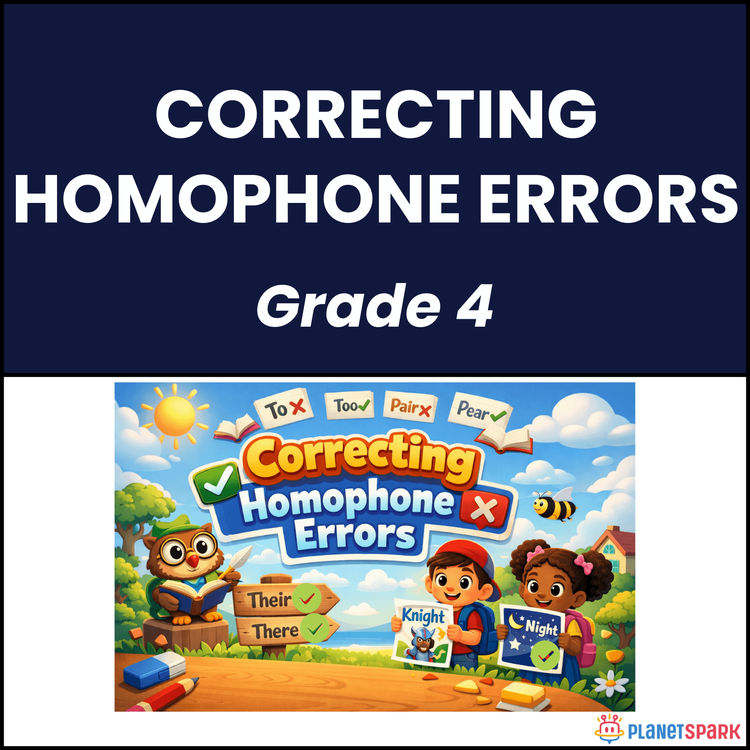
This Grade 4 worksheet is thoughtfully designed to help students master homophones—words that sound the same but have different spellings and meanings. By exploring common homophone pairs in engaging and varied contexts, this resource empowers young learners to recognize, understand, and correctly use these tricky words in their writing. Through a series of interactive exercises, students will build the confidence to choose the right word every time.
Why Mastering Homophones Matters in Grammar?
For Grade 4 students, correctly using homophones is essential for clear and accurate written communication. This topic is important because:
1. Homophones are among the most common sources of spelling and grammar errors in everyday writing.
2. Mastering them strengthens vocabulary by teaching multiple meanings and spellings for the same sounds.
3. It improves reading comprehension as students learn to distinguish meaning through context clues.
What's Inside This Worksheet?
This worksheet includes five engaging activities to build a strong foundation in homophones:
Exercise 1 – Match the Following
Students draw lines to connect each word on the left to its correct homophone on the right. This visual activity introduces common homophone pairs in a simple and effective way.
Exercise 2 – Sort the Words
This critical thinking exercise asks students to analyze word pairs and sort them into two categories: "Homophones" and "Not Homophones." This reinforces the definition of a homophone and sharpens their listening and spelling skills.
Exercise 3 – Fill in the Blanks
Students choose the correct homophone from a list to complete each sentence. This helps them understand how context determines which spelling and meaning is appropriate.
Exercise 4 – Multiple Choice Questions
This classic exercise presents sentences with a missing word, offering multiple homophone options. Students must select the correct one, building their recognition and recall skills.
Exercise 5 – Sentence Rewriting
Each sentence in this exercise contains an incorrect homophone. Students must identify the error and rewrite the sentence correctly, building essential editing and proofreading skills.
Answer Key
Exercise 1 – Match the Following
None – Nun
Sow – So
Flew – Flu
Bury – Berry
Role – Roll
Cereal – Serial
Wear – Where
Tail – Tale
Your – You're
Knew – New
Exercise 2 – Sort the Words into Homophones and Not Homophones
Homophones: (None, Nun), (Sow, So), (Flew, Flu), (Bury, Berry), (Role, Roll), (Cereal, Serial), (Wear, Where), (Tail, Tale), (Your, You're), (Knew, New)
Not Homophones: (Cat, Bat), (Book, Look), (Run, Sun), (Happy, Sad), (Big, Small)
Exercise 3 – Fill in the Blanks (Word from Page 5)
1. None
2. Sow
3. Flew
4. bury
5. role
6. Cereal
7. Wear
8. tail
9. Your
10. Knew
Exercise 4 – Multiple Choice Questions
1. c) sole
2. a) him
3. a) aloud
4. b) medal
5. b) wait
6. a) ring
7. d) site
8. c) vein
9. b) scent
10. d) they're
Exercise 5 – Sentence Rewriting
1. The meeting lasts one hour.
2. Riya has eight pencils in her bag.
3. Raj can see the board now.
4. Meera has two cats at home.
5. I want to buy a new phone.
6. The medicine will heal you.
7. The bridge is made of steel.
8. Ice cream is my favorite dessert.
9. Please raise your hand.
10. Flowers die without water.
Help your child master tricky homophones and become a spelling superstar with a Free 1:1 Communication Skills Trial Class at PlanetSpark.
Frequently Asked Questions
Homophones are words that sound the same but have different meanings, like "right" and "write." Practice with examples helps students use them properly.
They may struggle because homophones often sound alike but have distinct meanings. Contextual sentences can help clarify the difference.
Teachers can use word games, sentence examples, and visual aids to reinforce correct usage of homophones.