
Class 7 Grammar Worksheet on Foreshadowing Skills

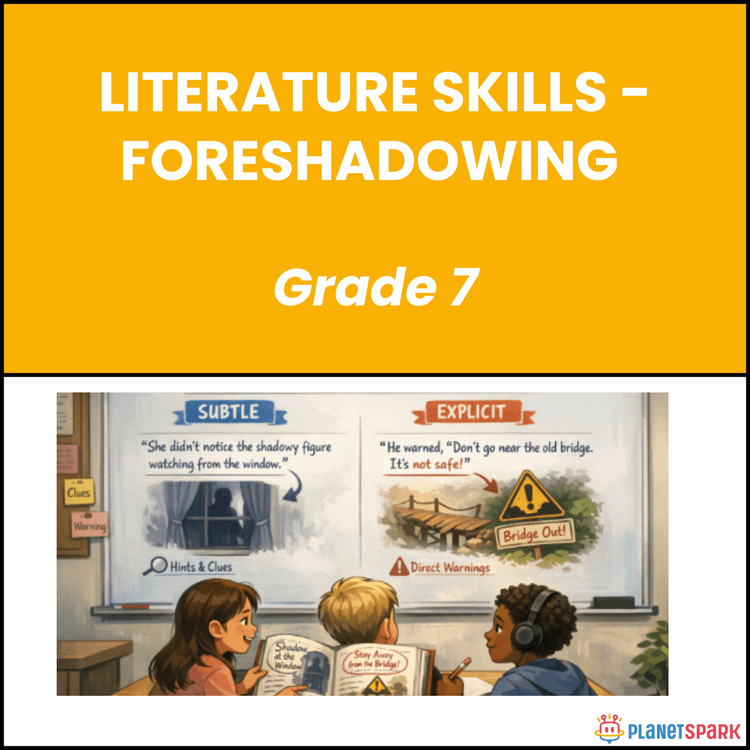
Class 7 Grammar Worksheet on Foreshadowing Skills
Hints Ahead: Foreshadowing Skills for Class 7
This Grade 7 literature skills worksheet helps learners explore foreshadowing, both subtle and explicit, in storytelling. Students practice identifying foreshadowing techniques in multiple-choice questions, completing fill-in-the-blank tasks with key terms, judging statements in true/false exercises, underlining foreshadowing clues in sentences, and analyzing a passage to explain how foreshadowing builds tension and prepares readers for future events. These varied activities build narrative awareness, critical thinking, and reading fluency in CBSE/IB English classrooms.
Why Foreshadowing Matters in Literature?
1. It prepares readers for upcoming events and builds anticipation.
2. It teaches students how subtle hints and explicit warnings shape narrative flow.
3. It develops analytical skills by connecting clues to outcomes.
4. It strengthens storytelling ability and enhances comprehension of literary techniques.
What’s Inside This Worksheet?
🧠 Exercise 1 – Multiple Choice Questions
Students identify foreshadowing techniques like subtle clues, explicit warnings, and signals.
✏️ Exercise 2 – Fill in the Blanks
Learners complete sentences using foreshadowing-related terms.
✔️ Exercise 3 – True or False
Students judge statements about foreshadowing in stories.
🔄 Exercise 4 – Underline Clues
Learners underline words or phrases that act as foreshadowing clues in sentences.
📝 Exercise 5 – Passage Analysis
Students explain how foreshadowing is used in a short passage.
✅ Answer Key (For Parents & Educators)
Exercise 1 – Multiple Choice
1. b) foreshadowing
2. b) explicit
3. a) subtle
4. a) explicit
5. b) subtle
6. a) foreshadowing
7. b) subtle
8. b) explicit
9. c) signal
10. c) tension
Exercise 2 – Fill in the Blanks
1. unease
2. prediction
3. dread
4. clue
5. outcome
6. expectation
7. tension
8. implication
9. signal
10. indication
Exercise 3 – True or False
1. False
2. True
3. True
4. False
5. True
6. False
7. True
8. False
9. False
10. True
Exercise 4 – Underline Foreshadowing Clues
1. lantern through the cave
2. sky darkened, wind rose
3. warned danger would come soon
4. shadow moved near window
5. silence made place unsafe
6. sign near broken bridge
7. wind howled before storm
8. remembered a dream
9. crack appeared in wall
10. dog barked loudly in dark
Exercise 5 – Passage Analysis
Foreshadowing examples: “strange silence,” “broken branches,” “distant sound,” “dark clouds gathered,” “rustling footsteps.”
Sample Answer: These clues create unease and anticipation, signaling danger and preparing readers for future events.
(Answers may vary)
Help your child master foreshadowing and literary analysis with engaging Class 7 practice.
Frequently Asked Questions
Foreshadowing is a technique where hints are given early in a story about what may happen later, helping students improve prediction skills in English worksheets.
A grammar worksheet can provide examples and exercises where students identify and create hints in short passages.
It helps early learners think critically about story development and improves their comprehension in CBSE English lessons.