
Class 7 Grammar Worksheet on Modals with Conditionals

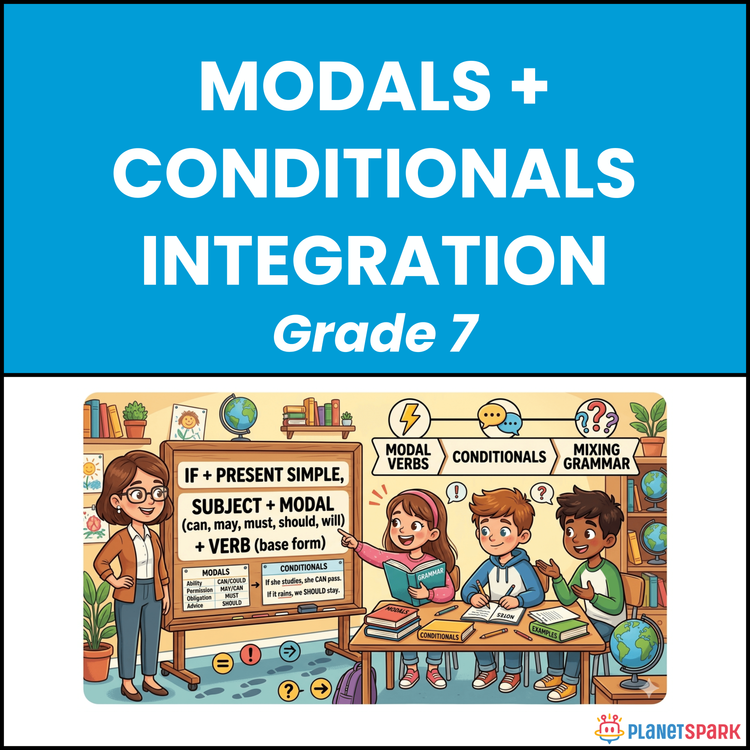
Class 7 Grammar Worksheet on Modals with Conditionals
Conditionally Smart: Modals with Conditionals Grammar Worksheet for Class 7
Understanding how modal verbs work with conditional sentences helps students' express possibility, advice, ability, certainty, and hypothetical situations more effectively. This Grade 7 grammar worksheet on Modals with Conditionals Integration is designed to strengthen sentence construction and improve advanced grammar usage in both writing and speaking.
Through carefully designed activities, learners practice combining modal verbs such as can, could, may, might, should, would, and must with zero, first, second, third, and mixed conditional structures. The exercises gradually help students understand how grammar changes depending on real, unreal, possible, or imagined situations.
Why Modals with Conditionals Matter in Grammar?
Modals and conditionals are important building blocks for higher-level English communication. For Grade 7 learners, this topic is essential because:
1. It helps students express possibility, advice, obligation, and hypothetical outcomes clearly.
2. It improves sentence accuracy in formal and creative writing.
3. Students learn how verb forms change across different conditional structures.
4. It develops logical thinking by connecting causes with results.
5. It strengthens grammar confidence for school assessments and communication tasks.
What’s Inside This Worksheet?
This worksheet includes five grammar-focused activities that build fluency with modals-conditionals integration:
Exercise 1 – Underline the Errors
Students identify incorrect modal or verb forms in conditional sentences and recognize grammar inconsistencies.
Exercise 2 – Multiple Choice Questions
Learners choose the correct modal verb based on the conditional sentence structure and context clues.
Exercise 3 – Sentence Rewriting
Students rewrite simple sentences into first, second, third, zero, or mixed conditional forms using specific modal verbs.
Exercise 4 – Paragraph Fill in the Blanks
A real-life paragraph-based grammar activity where students complete sentences using suitable modal-conditionals combinations.
Exercise 5 – Paragraph Writing
Students write a short paragraph about helping society using responsibility and kindness while applying modal-conditionals structures creatively.
Answer Key (For Parents & Educators)
Exercise 1 – Underline the Errors
1. Aarav will join if he would finish.
2. Kiara could have won if she tries.
3. Vihaan can helps if he knows.
4. Anaya would joins if she were free.
5. Ishaan should came if he promises.
6. Myra might solve it if she had tried.
7. Kabir may joined if he gets time.
8. Saanvi would help if she is ready.
9. Reyansh must waits if he is late.
10. Advika can attended if she finishes.
Exercise 2 – Multiple Choice Questions
1. c) could have
2. a) will
3. b) could
4. a) might have
5. c) may
6. b) would
7. b) should have
8. c) can
9. a) might
10. c) would have
Exercise 3 – Sentence Rewriting
1. If Vedant misses the school bus, he will arrive late.
2. If Navya lost the debate notes, she would feel worried.
3. If Reyansh had heeded the warning, he could have avoided danger.
4. If Aarohi heats the metal rod, she must handle it carefully.
5. If Kabir had revised, he would feel confident now.
6. If Ishita follows the route, she may reach early.
7. If Pranay had the entry pass, he might enter the hall.
8. If Tanvi had kept the permission slip, she should have shown it.
9. If Dhruv mixes oil with water, he can observe separation.
10. If Samaira had attended the meeting, she could explain the plan now.
Exercise 4 – Paragraph Fill in the Blanks
During the monsoon, Class 7 students at a Pune school planned a relief drive for a flooded lane near the market. If Ayaan had checked the weather alert earlier, the team could have postponed the visit. If Diya brings extra notebooks, younger children will receive clean pages for homework. If Kabir were the group leader, Kabir would arrange the food packets more carefully. If Niyati had labelled the cartons, the volunteers could have avoided confusion near the school gate. If Samar follows the teacher’s instructions, Samar should carry only safe items. If Rhea had charged the phone, the team might have contacted the bus driver quickly. If Laksh helps the guard, the boxes can move faster. If Mehul were more patient, Mehul would explain the plan clearly. If Tara had worn rain shoes, Tara could have walked through the muddy lane safely. If the students cooperate, the drive will support many families before evening.
Exercise 5 – Paragraph Writing (Sample Answer)
If students used responsibility and kindness, society would become safer and more helpful. Students could keep their classrooms, streets, and parks clean if students followed simple rules every day. If students saw someone in need, students should offer help politely. Students would save water and electricity if students understood their duty toward the environment. If students respected elders, teachers, and workers, communities would become more caring. Students might inspire others if students acted honestly in school and public places. If every student used kind words and responsible actions, India could grow into a cleaner, stronger, and happier society.
Help your child strengthen advanced grammar and sentence-building skills with engaging conditional and modal practice designed for confident communication success.
Frequently Asked Questions
They combine modal verbs with conditional sentences to express possibility, advice, or certainty in different situations.
It helps them form more accurate and meaningful sentences when talking about results and possibilities.
A simple examples can be if you study, you should pass, if she tries, she might succeed, and if they hurry, they can catch the bus.