
Class 7 Worksheet on Subordination and Coordination

Class 7 Worksheet on Subordination and Coordination
Link Ideas Like a Pro: Subordination vs Coordination for Class 7
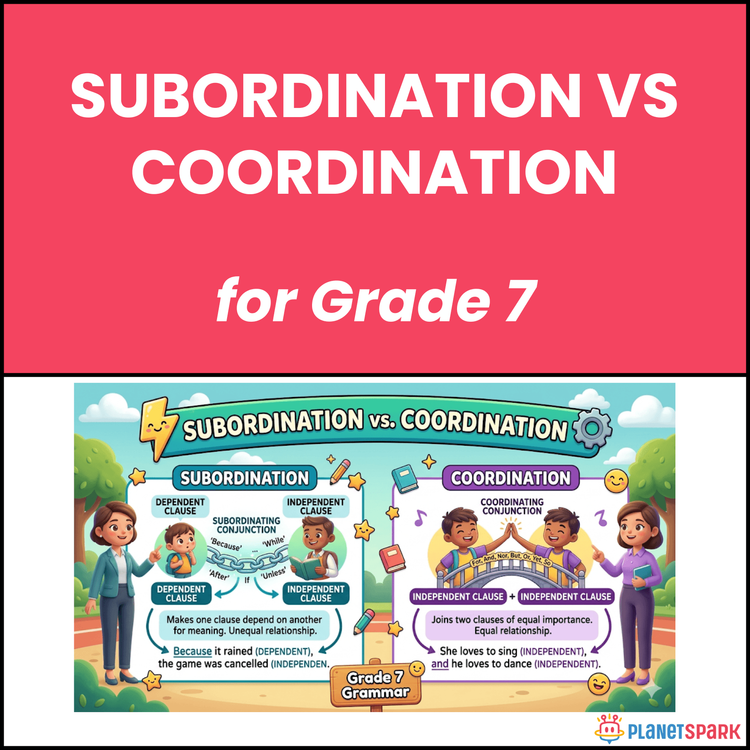
This Grade 7 worksheet on Subordination vs Coordination helps students understand how different clauses connect ideas in meaningful ways. By learning when to use coordinating conjunctions like and, but, and so, and subordinating words like because, although, and when, learners improve sentence flow, logical relationships, and overall writing clarity.
Why Subordination and Coordination Matter in Grammar?
Subordination and coordination are essential sentence-building skills that help students organize ideas effectively. For Grade 7 learners, this topic is important because:
1. It teaches students how to connect related ideas smoothly.
2. It helps distinguish equal ideas from dependent ideas in writing.
3. It improves sentence variety and logical flow.
4. It strengthens both academic and creative writing skills.
What’s Inside This Worksheet?
Students move from identifying clause structures to constructing well-connected sentences through guided grammar practice.
🧠 Exercise 1 – Identify Clauses and Conjunctions
Students underline subordinate clauses and circle coordinating conjunctions to recognize how sentence parts connect.
✏️ Exercise 2 – Multiple Choice Questions
Students identify subordinated and coordinated sentence structures, helping them understand relationships between clauses.
📋 Exercise 3 – Sentence Combining
Students combine short sentences using coordinating conjunctions, subordinating clauses, contrast clauses, and time clauses.
📝 Exercise 4 – Fill in the Blanks
Students complete a grammar passage using words related to coordination, subordination, and sentence structure.
✍️ Exercise 5 – Paragraph Writing
Students write a paragraph on “Balancing Ideas in Writing” using at least two coordinated and two subordinated sentences. They must include at least one cause clause and one contrast clause to demonstrate understanding of clause relationships.
A strong response will include coordinated sentences (e.g., “The teacher explained, and students listened carefully.”) and subordinated sentences (e.g., “Although she was tired, Meera completed her notes.”).
✅ Answer Key (For Parents & Educators)
Exercise 1 – Subordinate Clauses and Coordinating Conjunctions
1. because exams are near
2. although she feels tired
3. so
4. and
5. but
6. and
7. and
8. because he wants success
9. when the coach watches him
10. although she was nervous
Exercise 2 – Multiple Choice Questions
1. a) Riya studies because exams are near.
2. b) Ravi plays cricket, and he enjoys it.
3. a) Meera writes notes although she feels tired.
4. a) Asha reads books, and she likes them.
5. b) Raj runs fast because he wants to impress the coach.
6. c) The teacher explains, and students listen.
7. b) The boy studies because he wants success.
8. c) The bus arrived late, so we waited longer.
9. c) The girl smiled although she was nervous.
10. c) The dog followed him, and it stayed close.
Exercise 3 – Sentence Combining (Sample Answers)
1. Riya studies because exams are near.
2. Meera writes notes, and she feels tired.
3. Asha reads books although she prefers silence.
4. Ravi plays cricket, and he enjoys it.
5. Raj runs fast when the coach watches him.
6. The teacher explains, and students listen.
7. We waited longer because the bus arrived late.
8. The girl smiled, so everyone felt relaxed.
9. The boy studies although he wants success quickly.
10. The dog followed him, and it stayed close.
Exercise 4 – Fill in the Blanks
1. subordinate
2. independent
3. coordinating
4. subordinating
5. clear
6. logical
7. smooth
8. sentence
9. balanced
10. written
Exercise 5 – Paragraph Writing (Sample Answer)
Balancing Ideas in Writing
Good writing connects ideas clearly, and it helps readers understand thoughts easily. Writers use coordination when two ideas are equally important, but they use subordination when one idea depends on another. Although long sentences add detail, short sentences improve clarity. I enjoy writing paragraphs because they allow me to organize ideas smoothly. Strong sentence structure makes communication more effective, and it improves overall readability.
Help your child connect ideas more clearly and confidently through structured grammar practice that builds stronger writing skills.
🔖Book a free trial!
Frequently Asked Questions
Coordination joins equal ideas using conjunctions like and or but, while subordination connects dependent ideas using words like because or although.
It helps students express complex ideas clearly and improves sentence structure in academic writing.
They can look for words that introduce reasons, time, or conditions, such as because, when, or if.