
Class 7 English Worksheet on Evidence in Arguments

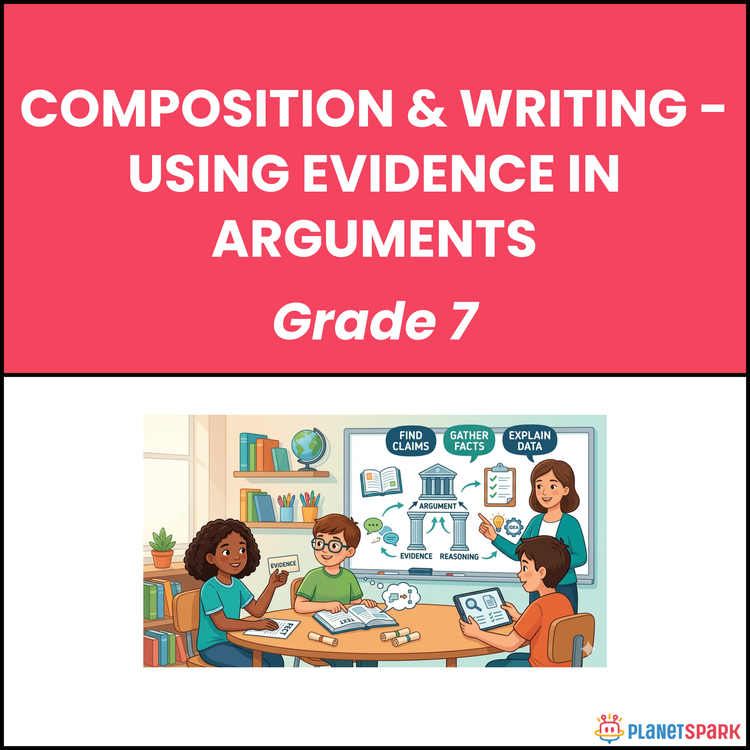
Class 7 English Worksheet on Evidence in Arguments
Proof Over Noise: Evidence in Arguments Worksheet for Class 7
This Grade 7 worksheet focuses on “Using Evidence in Arguments”, helping students understand how facts, proof, and logical reasoning strengthen opinions and claims. Built around an engaging story, learners explore how evidence can change perspectives and lead to fair conclusions.
Through a variety of thoughtfully designed exercises, students practice identifying key details, analyzing cause and effect, and distinguishing between assumptions and proof. The worksheet includes multiple choice questions, fill in the blanks, true/false evaluation, error identification, and paragraph completion tasks — all aligned with real comprehension and grammar skills.
Why Evidence in Arguments Matters in Grammar?
Understanding how to use evidence is an essential communication skill for middle school learners. This topic is important because:
1. It helps students support their ideas with facts instead of opinions.
2. It builds logical thinking and reasoning skills.
3. It strengthens reading comprehension and analytical ability.
4. It prepares students for structured writing and debate.
What’s Inside This Worksheet?
This worksheet includes five engaging exercises designed to build clarity and reasoning skills:
Exercise 1 – Multiple Choice Questions
Students read the story carefully and answer comprehension-based questions to identify key events, characters, and lessons.
Exercise 2 – Fill in the Blanks
Student's complete sentences using appropriate words from a given word bank, reinforcing vocabulary and contextual understanding.
Exercise 3 – True or False
Students evaluate statements and decide whether they align with the story, strengthening attention to detail.
Exercise 4 – Underline the Incorrect Word
Students identify and underline the word that does not match the meaning or facts from the story.
Exercise 5 – Paragraph Completion
Students fill in a structured paragraph using clues from the story, helping them connect ideas logically and coherently.
Answer Key (For Parents & Educators)
Exercise 1 – Multiple Choice Answers
1. a) Jetty Road in Mangaluru
2. b) Bhaskar
3. d) They are not proof
4. c It was rubbed thin
5. b) Black grease
6. a) The cart rolled backward and hit the rope
7. b) Tide chart
8. d) Tanvi’s argument used evidence
9. a) Before you accuse, prove
10. c) Evidence makes arguments stronger
Exercise 2 – Fill in the Blanks
1. evidence
2. accused
3. grease
4. camera
5. tide
6. argument
7. proof
8. lantern
9. snapped
10. apologized
Exercise 3 – True / False
1. False
2. True
3. True
4. False
5. False
6. True
7. True
8. True
9. False
10. False
Exercise 4 – Incorrect Word Identification
1. Temple → Jetty
2. painter → guard
3. rumours → evidence
4. scissors → friction
5. lantern → cart
6. noon → night
7. thanked → blamed
8. colour → force
9. ignored → examined
10. hide → prove
Exercise 5 – Paragraph Completion
evidence, grease, argument, cut, cart, left, truth, claim, reasoning
Help your child develop strong reasoning and evidence-based writing skills with engaging Grade 7 worksheets designed for real understanding and confidence building.
Frequently Asked Questions
Evidence in arguments refers to facts, examples, or data that support a claim and make the writer’s point more believable.
Early learners can practice by adding simple facts or examples after stating their opinion to make their writing clearer and stronger.
Evidence is based on facts or proof, while an opinion is a personal belief that may not always be supported.