
Class 6 English Worksheet on Be Going To Future Plans

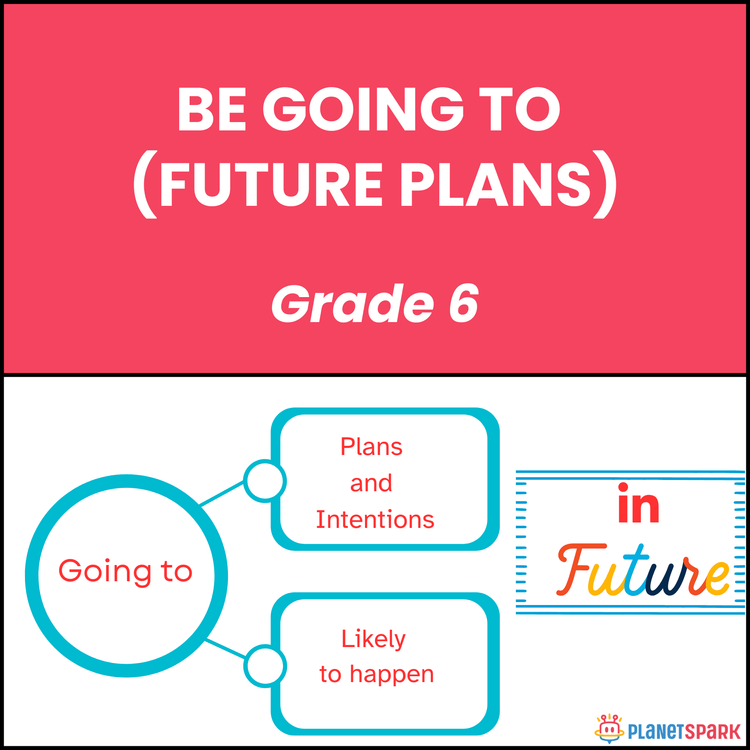
Class 6 English Worksheet on Be Going To Future Plans
Future Plans Made Easy: Mastering “Be Going To” for Grade 6
This Grade 6 worksheet focuses on using “be going to” to talk about future plans and intentions. Students will practice forming correct sentences using “am,” “is,” and “are going to” in different contexts. Through a variety of engaging exercises, learners will strengthen their understanding of how to express planned actions clearly and confidently in both writing and speaking.
Why Be Going To (Future Plans) Matter in Grammar?
Understanding how to talk about future plans is an essential grammar skill. For Grade 6 learners, this topic is important because:
1. It helps students express future intentions and planned actions clearly.
2. It builds correct subject-verb agreement using “am,” “is,” and “are.”
3. It improves sentence formation in everyday communication.
4. It helps learners distinguish between planned actions (“going to”) and spontaneous decisions.
What’s Inside This Worksheet?
This worksheet includes five engaging exercises designed to help students master “be going to”:
🧠 Exercise 1 – Multiple Choice Questions
Students choose the correct form of “be going to” to complete each sentence correctly. (Pages 3–4)
✏️ Exercise 2 – True or False
Students decide whether each sentence correctly uses “be going to” for future plans. (Page 5)
📋 Exercise 3 – Fill in the Blanks
Learners fill in the blanks with the correct form of “be going to,” reinforcing proper usage. (Page 6)
📝 Exercise 4 – Sentence Rewriting
Students rewrite sentences using “be going to” instead of “will” to express planned actions. (Pages 7–8)
🎯 Exercise 5 – Paragraph Completion
Students complete a paragraph about future travel plans using correct forms of “be going to.” (Page 9)
✅ Answer Key (For Parents & Educators)
Exercise 1 – Multiple Choice Question
1. am going to
2. is going to
3. are going to
4. are going to
5. is going to
6. are going to
7. is going to
8. are going to
9. is going to
10. am going to
Exercise 2 – True or False
1. True
2. True
3. False
4. False
5. False
6. False
7. False
8. True
9. False
10. True
Exercise 3 – Fill in the Blanks
1. am going to
2. is going to
3. are going to
4. are going to
5. is going to
6. are going to
7. is going to
8. are going to
9. is going to
10. am going to
Exercise 4 – Rewritten Sentences
1. She is going to visit her grandmother next weekend.
2. I am going to complete my homework tomorrow.
3. He is going to buy a new car next year.
4. They are going to travel to New York next summer.
5. We are going to start the project next week.
6. She is going to attend the meeting tomorrow.
7. I am going to study for my exams next week.
8. He is going to cook dinner this evening.
9. They are going to play football on Saturday.
10. We are going to go picnic tomorrow.
Exercise 5 – Paragraph Completion
1. am going to
2. are going to
3. am going to
4. is going to
5. are going to
6. are going to
7. are going to
8. are going to
9. am going to
10. am going to
11. am going to
12. is going to
Help your child confidently talk about future plans and improve grammar accuracy with these engaging exercises.
Frequently Asked Questions
Be going to is used to talk about plans or intentions, like "I am going to study tomorrow."
The structure is simple: subject + am/are/is + going to + verb, e.g., "She is going to read a book."
Use "be going to" for planned actions, especially when there’s an intention or decision already made.