
Class 6 Homonyms Same Spelling Different Meaning

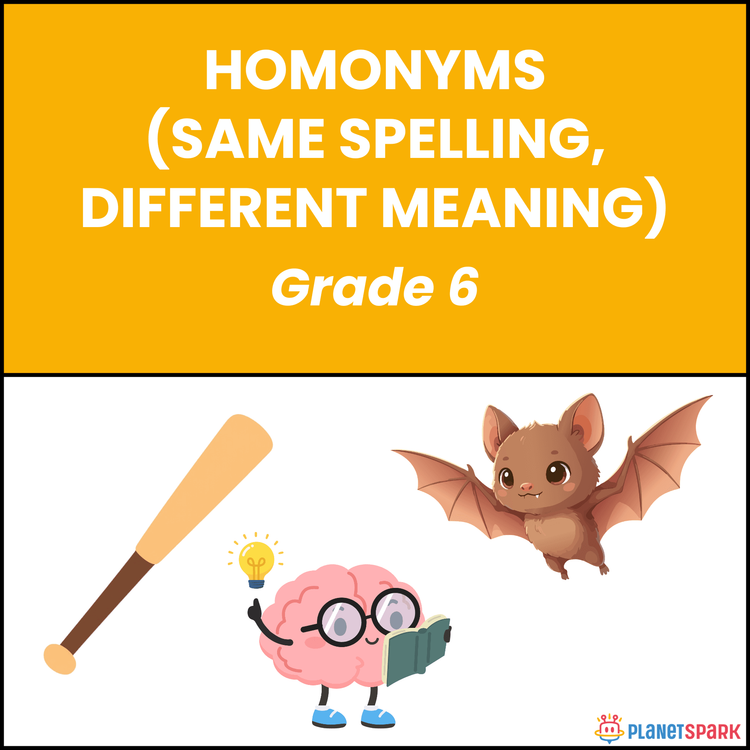
Class 6 Homonyms Same Spelling Different Meaning
Double Duty Words: Homonyms with Same Spelling, Different Meaning for Class 6
This Grade 6 worksheet focuses on the fascinating category of homonyms that share not just pronunciation but also spelling — yet carry entirely different meanings in different contexts. Through five engaging activities including match the following, sort the words, fill in the blanks, multiple choice questions, and sentence rewriting, students explore how words like bat, bank, bark, light, ring, spring, palm, match, fair, and wave can function in multiple ways within the English language.
Why Homonyms (Same Spelling, Different Meaning) Matter in Grammar?
These homonyms represent one of the most nuanced aspects of English vocabulary. For Grade 6 learners, this topic is important because:
1. A single word may serve as a noun in one sentence and a verb in another.
2. Contextual reading skills are essential to select the correct meaning.
3. Misidentifying the meaning of such words leads to reading comprehension errors.
4. This skill strengthens students' ability to analyse language precisely and thoughtfully.
What's Inside This Worksheet?
This worksheet includes five grammar-rich activities that build fluency with homonyms sharing the same spelling but different meanings:
Exercise 1 – Match the Following
Students match each homonym on the left to one of its meanings on the right. Example: bat → a flying mammal, bank → river side, bark → a tree sound, light → to light up, ring → finger jewelry, spring → a season, palm → hand part, match → game start, fair → a festival, wave → water movement.
Exercise 2 – Sort the Words
Students sort word pairs into Noun form and Verb form. Pairs include book/novel, book/read, ring/bell, ring/wear, light/sun, light/fire, watch/time, watch/look, water/drink, water/plants, back/body, back/return, match/game, match/fit, and tie/knot.
Exercise 3 – Fill in the Blanks
Students choose the correct meaning of a homonym to fill in each sentence. Example: "Rahul hit the ball with a wooden __________." (bat / racket)
Exercise 4 – Multiple Choice Questions
Students select the correct homonym from four options to complete each sentence. Example: "The dog has a sharp __________." (nail / mail / sail / tail)
Exercise 5 – Sentence Rewriting
Students rewrite sentences where the wrong meaning of a homonym was used. Example: "Rahul sat on the bat of the river to fish" becomes "Rahul sat on the bank of the river to fish."
Answer Key (For Parents & Educators)
Exercise 1 – Match the Following
bat → a flying mammal
bank → river side
bark → a tree sound
light → to light up
ring → finger jewelry
spring → a season
palm → hand part
match → game start
fair → a festival
wave → water movement
Exercise 2 – Sort the Words
Noun form: book/novel, ring/bell, light/sun, watch/time, water/drink, back/body, match/game, tie/knot
Verb form: book/read, ring/wear, light/fire, watch/look, water/plants, back/return, match/fit
Exercise 3 – Fill in the Blanks
1. bat
2. bank
3. bark
4. light
5. ring
6. spring
7. palm
8. match
9. palm
10. wave
Exercise 4 – Multiple Choice Questions
1. d) nail
2. a) nail
3. c) bark
4. a) bark
5. b) ring
6. b) rang
7. a) fair
8. b) fare
9. d) bank
10. c) bank
Exercise 5 – Sentence Rewriting
1. Rahul sat on the bank of the river to fish.
2. Anjali heard the bark of the dog at night.
3. Diya wore a ring on her finger to the fair.
4. Pooja lit the diya using a match from the box.
5. Arjun felt the light of the cool morning breeze.
6. Kartik watched the bat fly high over Delhi.
7. Neha waved her palm to greet the principal.
8. Rohan played cricket using a bat near the field.
9. Aarav sat under the palm tree in the garden.
10. The bank of the river gleamed in the afternoon sun.
Help your child navigate the richness of English vocabulary — book a Free 1:1 Grammar Trial Class at PlanetSpark and build confident, articulate learners.
Book a free trial!
Frequently Asked Questions
Homonyms are words that have the same spelling but different meanings, like "bat" (the animal) and "bat" (used in baseball).
Students can misunderstand homonyms because the same word has multiple meanings based on context.
Worksheets provide examples where learners identify and use homonyms correctly based on context.