
Grade 3 Worksheet on Singular and Plural Nouns

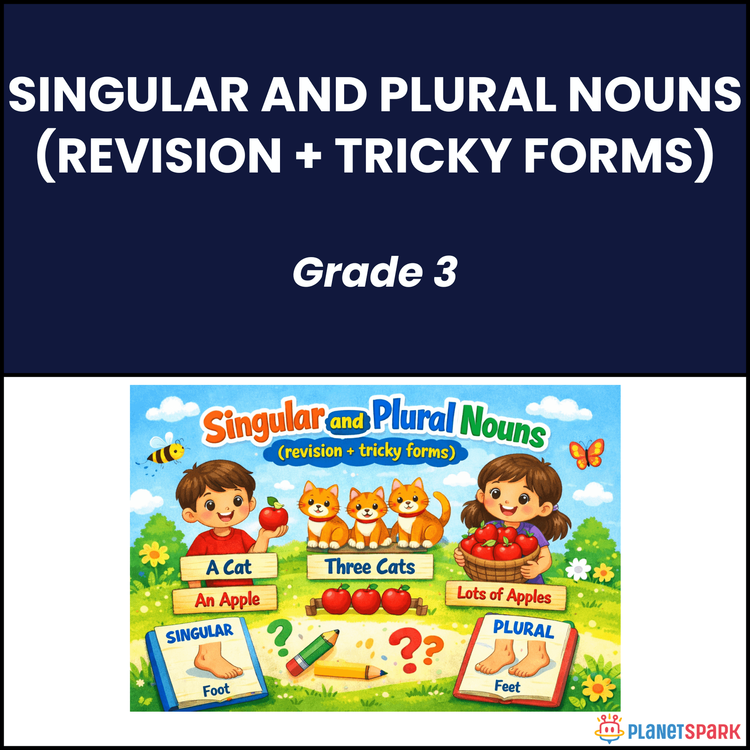
Grade 3 Worksheet on Singular and Plural Nouns
One or Many Matters: Singular and Plural Nouns for Grade 3
This Grade 3 English grammar worksheet focuses on revising singular and plural nouns with special attention to tricky forms that often confuse young learners. Designed for CBSE-aligned students, the worksheet builds strong grammar foundations through structured, age-appropriate practice.
Why Singular and Plural Nouns Matter in Grammar?
Understanding singular and plural nouns helps Grade 3 learners express quantity clearly and correctly. This topic is important because:
1. Nouns change form based on number.
2. Singular and plural usage affects sentence meaning.
3. Many nouns follow special or tricky plural rules.
4. Correct noun usage improves both writing and speaking accuracy.
What’s Inside This Worksheet?
This worksheet includes five engaging grammar activities designed to reinforce noun concepts:
Exercise 1 – Choose the Correct Option
Students select the correct singular or plural noun to complete each sentence using context clues.
Exercise 2 – Fill in the Blanks
Learners fill in sentences using correct singular or plural nouns from a word bank.
Exercise 3 – Match the Following
Students match pictures with the correct singular or plural noun forms, strengthening visual association.
Exercise 4 – Underline and Circle
Students underline the singular noun and circle the plural noun in each sentence to build identification skills.
Exercise 5 – Passage Completion
Learners complete a short paragraph by choosing appropriate singular and plural nouns based on meaning and grammar rules.
This worksheet is ideal for classroom practice, homework, grammar revision, and extra support at home.
Answer Key (For Parents & Educators)
Exercise 1 – Choose the Correct Option
1. passenger
2. notebook
3. worshipers
4. suitcase
5. workers
6. family
7. ornaments
8. children
9. flamingos
10. lunchbox
Exercise 2 – Fill in the Blanks
1. classroom
2. classmates
3. butterflies
4. vegetables
5. playground
6. vehicles
7. raincoat
8. raindrops
9. cupboard
10. doorstep
Exercise 3 – Match the Following
1. Alligator
2. Kangaroos
3. Backpack
4. Tomatoes
5. Umbrellas
6. Sunflower
7. Caterpillar
8. Chickens
9. Apricots
10. Strawberry
Exercise 4 – Underline Singular & Circle Plural
1. Books (plural), student (singular)
2. child (singular), animals (plural)
3. Apples (plural), vendor (singular)
4. teacher (singular), papers (plural)
5. birds (plural), farmer (singular)
6. Shoes (plural), boy (singular)
7. driver (singular), buses (plural)
8. girl (singular), flowers (plural)
9. Cars (plural), guard (singular)
10. painter (singular), walls (plural)
Exercise 5 – Passage Completion
1. bell
2. milk
3. fruits
4. shoes
5. dog
6. cats
7. flowers
8. bird
9. vegetables
10. flowers
11. raindrops
Build your child’s confidence in English grammar with guided practice and expert support.
Frequently Asked Questions
Adding 's' or 'es' is the most common rule, but some nouns change spelling to form plurals.
Many nouns do not follow one fixed rule, which can confuse early learners during writing.
Practice sentences and sorting activities help children recognize patterns and exceptions clearly.