
Class 2 Worksheet on To, Too, Two with Pictures

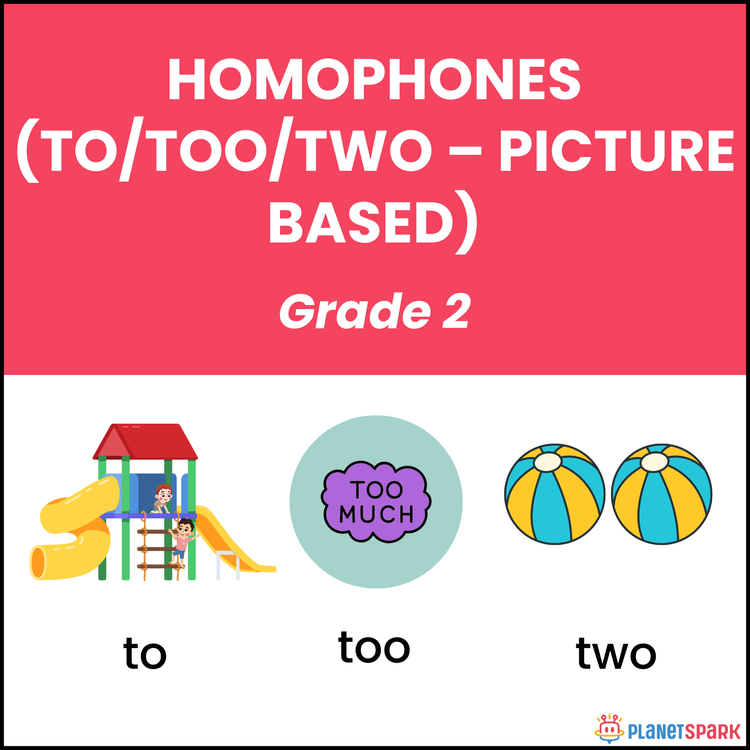
Class 2 Worksheet on To, Too, Two with Pictures
Picture Perfect Meanings: To, Too & Two for Class 2
This Grade 2 English grammar worksheet helps young learners clearly understand and correctly use the homophones to, too, and two through engaging picture-based activities and simple, real-life sentences. Designed for Class 2 students, it focuses on meaning-first grammar learning so children don’t just memorize spellings but truly understand how each word is used.
Why Homophones Matter in Grammar?
Homophones sound the same but have different meanings and spellings, which often confuses early learners. Understanding to, too, and two is especially important because these words are used frequently in daily reading and writing. This worksheet builds clarity by connecting each homophone with its correct meaning—direction, number, or excess—using visuals and context.
What’s Inside This Worksheet?
This worksheet includes five carefully structured grammar activities that make learning homophones easy and fun:
🧠 Exercise 1 – Match the Following
Students match phrases with the correct homophone (to, too, or two) using picture clues and familiar expressions.
✂️ Exercise 2 – Sort the Words
Learners sort word pairs into Homophones and Not Homophones, sharpening their ability to judge correct usage based on meaning.
✏️ Exercise 3 – Fill in the Blanks
Students choose the correct homophone from a given pair to complete each sentence logically.
📋 Exercise 4 – Multiple Choice Questions
Each sentence comes with options a), b), c), or d), helping students practice careful reading and decision-making.
📝 Exercise 5 – Sentence Rewriting
Students rewrite incorrect sentences using the correct homophone, building strong editing and grammar correction skills.
With its mix of visuals, sorting, and sentence-based practice, this worksheet builds strong foundational grammar skills in an age-appropriate and engaging way.
✅ Answer Key (For Parents & Educators)
Exercise 1 – Match the Following
1. two balloons
2. too fast
3. to the park
4. two cups
5. too cold
6. two candies
7. too hot
8. to the school
9. two girls
10. to the store
Exercise 2 – Sort the Words
Homophones
1. to/go
2. too/wet
3. two/mats
4. too/loud
5. to/study
6. two/birds
7. too/weak
8. two/years
Not Homophones
1. too/crayons
2. to/burgers
3. two/help
4. too/pens
5. too/dogs
6. to/cookies
7. two/fat
Exercise 3 – Fill in the Blanks
1. two
2. to
3. too
4. to
5. too
6. two
7. to
8. to
9. too
10. two
Exercise 4 – Multiple Choice Questions
1.a) too
2.c) two
3.b) to
4.c) to
5.a) too
6.b) to
7.b) two
8.c) to
9.b) too
10.a) two
Exercise 5 – Rewrite the Sentences
1. The bag is too heavy to carry.
2. Ravi has two balls in his kit.
3. They walked too quickly in rain.
4. We will go to the museum tomorrow.
5. Amit has bought two new shirts.
6. Let’s go to the park in the evening.
7. The cat jumped too high.
8. Reeta is going to meet her friend.
9. Mom gave too much rice.
10. The two kittens are looking very cute.
Give your child a confident start with homophones through expert-guided learning and fun practice.
Frequently Asked Questions
To shows direction or purpose, "too" means also or excessively, and "two" represents the number 2.
Encourage thinking of "too" as "also" or "more than needed" in a sentence.
Because both sound the same; focusing on meaning and context helps avoid mistakes.