
Class KG English Worksheet on Fine Motor Skills

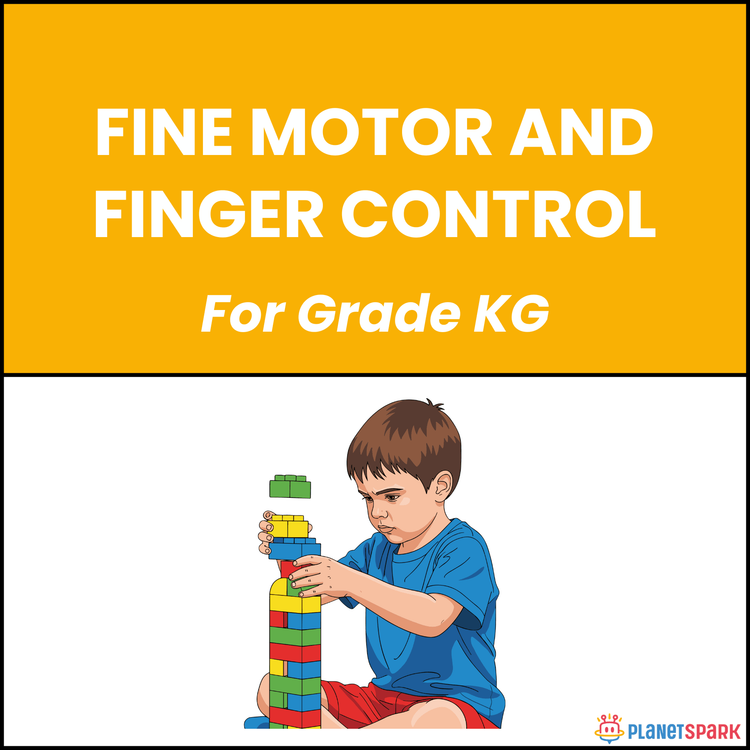
Class KG English Worksheet on Fine Motor Skills
Little Hands, Big Skills: Fine Motor & Finger Control for KG
This Kindergarten worksheet on Fine Motor and Finger Control helps young learners strengthen essential hand muscles and finger coordination needed for writing readiness. Through spiral tracing, letter tracing, finger writing, sand writing, and air writing, children develop control, precision, and confidence in forming letters.
Designed especially for KG students, this worksheet builds pre-writing foundations in a playful and structured way. Each activity gradually increases control — from simple spiral tracing to full uppercase letter formation using multi-sensory techniques.
Why Fine Motor Practice Matters in Early Learning?
Developing fine motor and finger control helps children:
1. Improve pencil grip and hand strength.
2. Build coordination between fingers and eyes.
3. Prepare for clear and confident letter formation.
4. Strengthen focus, patience, and movement control.
What’s Inside This Worksheet?
🌀 Exercise 1 – Trace the Spiral Slowly
Children carefully trace spiral patterns to improve circular hand movement and control.
🔤 Exercise 2 – Trace Big and Small Letters
Students trace uppercase letters first and then their matching lowercase letters (A–F), building letter recognition and stroke awareness.
👆 Exercise 3 – Finger Tracing
Children use their finger to trace large uppercase letters (A–P), following numbered stroke directions.
🏖️ Exercise 4 – Sand Writing Practice
Students practise writing uppercase letters (A–P) using their finger in sand, strengthening tactile learning and muscle memory.
✋ Exercise 5 – Air Writing
Children lift their hands and trace letters (A–D) in the air following directional arrows, improving movement sequencing and spatial control.
ANSWER KEY (For Parents & Educators)
Exercise 1 – Spiral Tracing
Students should trace each spiral smoothly from the outer edge toward the center without lifting the pencil.
Exercise 2 – Letter Tracing
Uppercase Letters – A, B, C, D, E, F
Lowercase Letters – a, b, c, d, e, f
Students trace the big letter first, then the small letter.
Exercise 3 – Finger Tracing Letters
A, B, C, D
E, F, G, H
I, J, K, L
M, N, O, P
Students follow the numbered stroke directions shown in the letters.
Exercise 4 – Sand Writing
Students write uppercase letters:
A B C D
E F G H
I J K L
M N O P
Exercise 5 – Air Writing
Students trace letters in the air:
A A A A
B B B B
C C C C
D D D D
(Tracing quality may vary depending on fine motor development stage.)
Help your child build strong writing foundations with engaging fine motor and multi-sensory letter practice designed especially for Kindergarten learners.
🔖Book a free trial!
Frequently Asked Questions
They involve small hand movements needed for writing and drawing.
Strong fingers help children hold pencils and write comfortably.
Tracing and drawing activities strengthen hand coordination.