
Class KG Worksheet on Trace and Match Sounds
Class KG Worksheet on Trace and Match Sounds
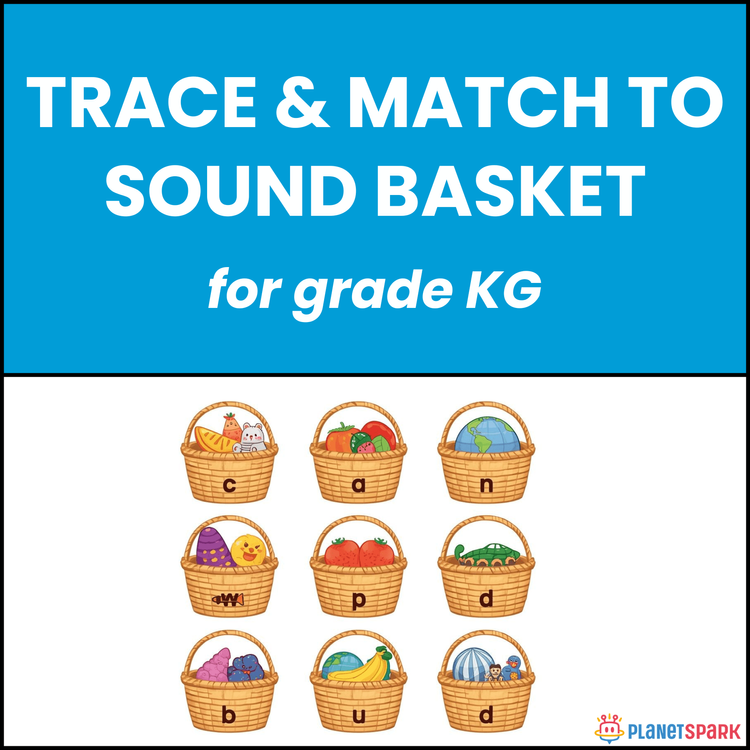
Trace & Match to Sound Basket: Beginning Sound Recognition for KG
This KG worksheet helps children strengthen their understanding of beginning consonant sounds through tracing, identifying, and matching activities. On page 3, students practise tracing uppercase letters such as P, R, D, G, J, F, Q, H, O, and Y by repeating each letter pattern before writing the final letter independently.
Learners then decide whether statements about consonants and consonant sounds are true or false (page 4), reinforcing their understanding of tall letters, consonant categories, and sound distinctions.
Pages 5–6 include picture-based MCQs where children choose the correct beginning sound for images like carrot, tomato, banana, orange, grapes, egg, fish, snake, chick, and spoon.
Finally, pages 7–8 allow students to choose and write words beginning with specific letters such as s, m, t, f, h, r, l, c, a, and b using a word bank supported by picture cues.
This worksheet builds critical early-reading skills by connecting visual pictures, starting sounds, and letter formation—all essential foundations for phonics success.
Why Beginning Sound Matching Matters?
Beginning-sound awareness helps children:
1. Build strong phonemic recognition for early reading.
2. Identify consonant sounds clearly and quickly.
3. Strengthen letter–sound connections during decoding.
4. Improve vocabulary recall through picture prompts.
What’s Inside This Worksheet?
🧠 Exercise 1 – Letter Tracing
Children trace and complete letters P, R, D, G, J, F, Q, H, O, Y using a repetition-based tracing path (page 3).
✏️ Exercise 2 – True or False
Learners evaluate statements about consonant sounds, tall consonants, and letters that make specific sounds (page 4).
📘 Exercise 3 – Multiple Choice (Beginning Sound)
Students match each picture to its starting sound—carrot → C, tomato → T, banana → B, orange → O, grapes → G, egg → E, fish → F, snake → S, hen/chick → H, spoon → S (pages 5–6).
📝 Exercise 4 – Choose and Write
Children write words beginning with each given letter using the picture-word bank (pages 7–8).
This worksheet supports early sound discrimination, develops handwriting, and builds vocabulary through engaging visuals.
ANSWER KEY ( for Parents and Educators)
Exercise 1 – Letter Tracing (Write the Final Letter)
1. P
2. R
3. D
4. G
5. J
6. F
7. Q
8. H
9. O
10. Y
Exercise 2 – True or False
1. True
2. True
3. True
4. True
5. True
6. False
7. True
8. True
9. False
10. True
Exercise 3 – Beginning Sound MCQs
1. carrot → C
2. tomato → T
3. banana → B
4. orange → O
5. grapes → G
6. egg → E
7. fish → F
8. snake → S
9. hen→ H
10. spoon → S
Exercise 4 – Choose & Write a Word
(Any correct word starting with the letter is acceptable; below are answers from the worksheet word bank.)
1. s → ship / sun
2. m → mango
3. t → tea
4. f → fan
5. h → hat
6. r → rat
7. l → log
8. c → car
9. a → ant
10. b → bat
Help your child build strong phonics foundations with beginning-sound activities that connect letters, sounds, and pictures for joyful early learning!
Fuel confident early reading skills with expert-led sound recognition and tracing practice—perfect for KG learners!
🔖Book a free trial!
Frequently Asked Questions
It teaches sound-to-letter mapping by tracing and matching beginning sounds.
They may not hear the starting sound clearly; modelling pronunciation helps.
Using real objects and asking kids to match the first sound improves retention.