
Class KG Worksheet on Tracing Small Letters

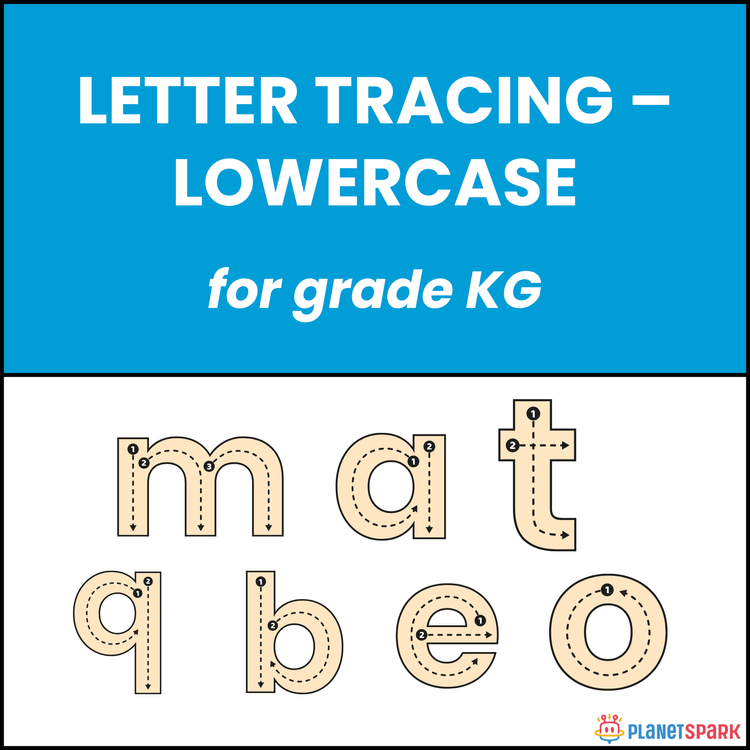
Class KG Worksheet on Tracing Small Letters
Trace to Read: Lowercase Letter Writing Practice for KG
This KG worksheet introduces young learners to lowercase letter tracing through simple, structured writing practice. Children trace letters like a, z, m, k, r, p, h, n, s, and d, as shown on page 3 of the worksheet, strengthening fine motor skills and improving handwriting fluency.
The worksheet also includes visual recognition tasks where children identify shapes and features of lowercase letters, building awareness of curves, straight lines, hooks, bumps, and tails. Finally, picture-supported word prompts help learners connect letters to meaningful vocabulary.
Why Lowercase Tracing Matters in Grammar?
Lowercase letter formation is a crucial early-writing skill because it helps children:
1. Build proper handwriting habits used in everyday writing
2. Strengthen letter-shape recognition for smoother reading
3. Develop hand–eye coordination and pencil control
4. Understand differences between similar-looking letters
What’s Inside This Worksheet?
Exercise 1 – Lowercase Tracing & Fill in the Blanks
Children trace each lowercase letter multiple times and then complete the missing final letter: a, z, m, k, r, p, h, n, s, d.
Exercise 2 – True or False
Learners judge statements about lowercase letter shapes—curves, slants, tall lines, bumps, hooks, and zig-zags .
Exercise 3 – Multiple Choice (Identify Letter Features)
Children choose the correct letter based on descriptions like “curved open,” “two bumps,” “tall hook,” “zig-zag,” and more .
Exercise 4 – Write a Word Beginning With the Given Letter
Using the picture-word bank (bed, pig, cup, log, yak, gum, jam, map, red, fox), learners write words that start with letters j, c, y, b, m, p, l, f, r, g.
This worksheet builds foundational writing fluency, supports early reading skills, and boosts learner confidence through fun, guided practice.
ANSWER KEY ( For Parents and Educators )
Exercise 1 – Trace and Complete the Letters
1. a
2. z
3. m
4. k
5. r
6. p
7. h
8. n
9. s
10. d
Exercise 2 – True or False
1. True
2. False
3. False
4. True
5. True
6. True
7. True
8. True
9. False
10. False
Exercise 3 – Multiple Choice
1. Curved open → c
2. Two bumps → m
3. Tall hook → f
4. Sharp edges → w
5. One tall line → l
6. Curves upward → u
7. Two slants → v
8. Ends with a tail → y
9. Starts with a curve → e
10. Zig-zag → z
Exercise 4 – Word Writing (Answers based on images and word bank)
1. j is for jam
2. c is for cup
3. y is for yak
4. b is for bed
5. m is for map
6. p is for pig
7. l is for log
8. f is for fox
9. r is for red
10. g is for gum
Help your child become confident with lowercase handwriting through guided tracing, fun visuals, and early reading connections—perfect for young beginners!
Boost your child’s writing fluency with expert-led KG handwriting sessions designed to make tracing fun and effective!
Book a free trial!
Frequently Asked Questions
Why is tracing small letters important for early learners?
Letters like b/d/p/q look alike; visual cues and repetition reduce confusion.
Using dotted guides and finger-tracing prepares kids before pencil work.